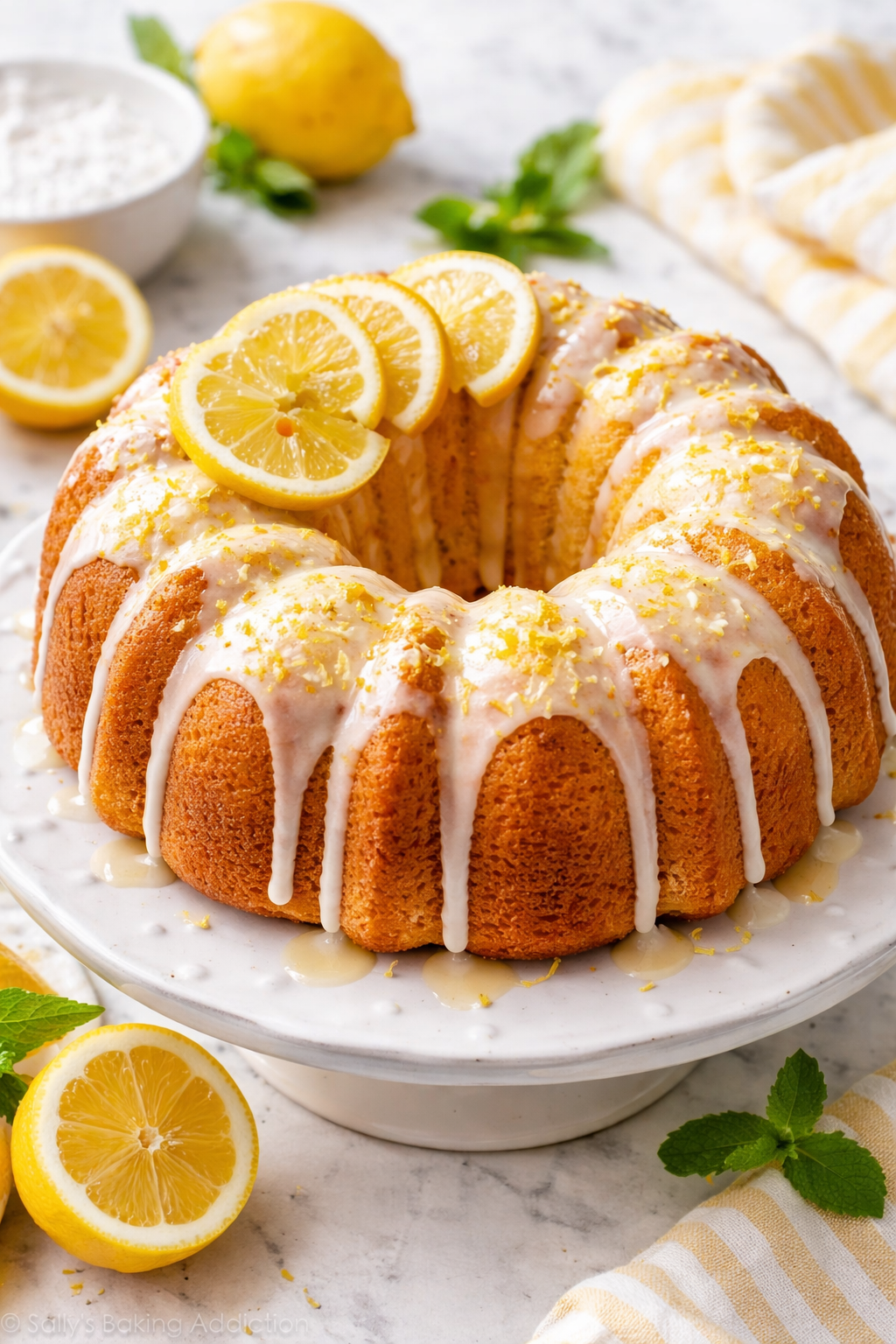
You bring it once and suddenly it’s “the thing you always make.”
No complaints here.
This lemon bundt cake is moist, dense in the best possible way, and has a bright citrus flavor that actually tastes like lemons, not just lemon-scented. The glaze drips down the sides in that dramatic way that makes people reach for their phones before they even cut into it.
And the fact that it feeds a crowd without requiring any layering, filling, or frosting skills? That’s the kind of baking win that never gets old.
Here’s exactly how to make it.
What You’ll Need
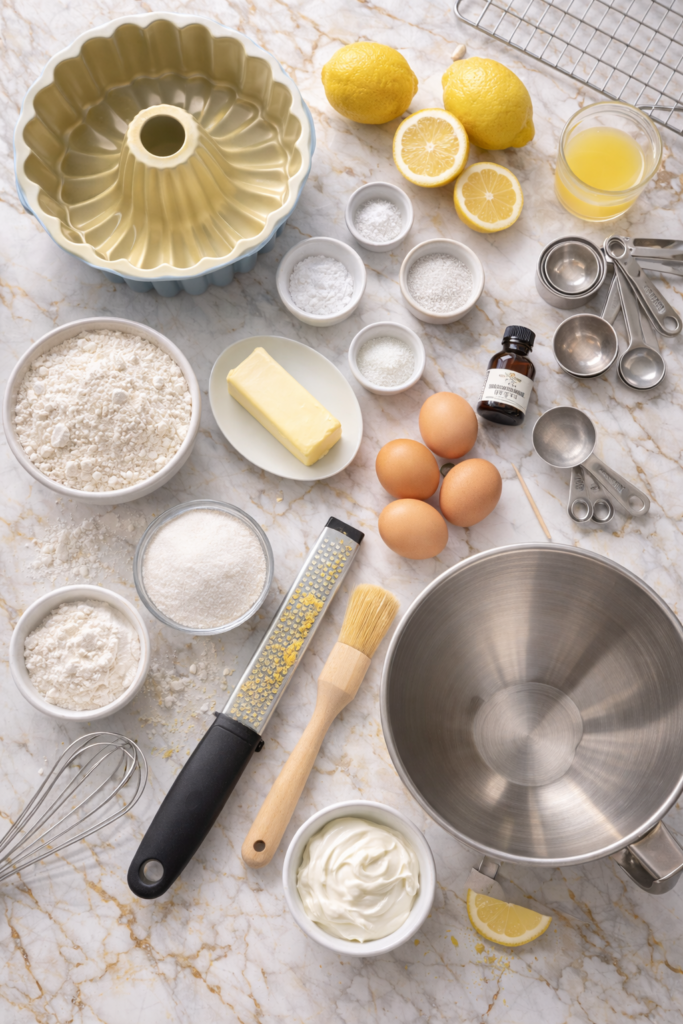
For the Cake
- 3 cups (375g) all-purpose flour
- 1 tsp baking powder
- ½ tsp baking soda
- ½ tsp fine sea salt
- 1 cup (226g) unsalted butter, softened to room temperature
- 2 cups (400g) granulated sugar
- 4 large eggs, room temperature
- 1 tbsp lemon zest (packed, from about 3-4 lemons)
- 3 tbsp fresh lemon juice
- 1 tsp pure vanilla extract
- 1 cup (240g) full-fat sour cream, room temperature
For the Lemon Glaze
- 1 ½ cups (180g) powdered sugar, sifted
- 3-4 tbsp fresh lemon juice
- 1 tsp lemon zest
Optional
- Powdered sugar for dusting
- Thin lemon slices for garnish
- Edible flowers for decoration
Tools You’ll Need
- 10-12 cup bundt pan
- Stand mixer or hand mixer
- Large mixing bowl
- Medium mixing bowl
- Rubber spatula
- Whisk
- Zester or microplane
- Measuring cups and spoons
- Wire cooling rack
- Pastry brush (for greasing the pan)
- Toothpick or cake tester
Pro Tips
Read these before you start. They’ll save you from the most common bundt cake disasters.
- Grease every single crevice of that bundt pan. Use softened butter and a pastry brush, getting into every groove, then dust with flour and tap out the excess. This is the step that determines whether your cake slides out beautifully or comes out in pieces. Don’t rush it.
- Room temperature ingredients are not optional. Cold butter won’t cream properly and cold eggs can cause the batter to curdle. Set everything out 30-60 minutes before baking.
- Do not overmix once the flour is added. Mix just until no dry streaks remain. Overmixing develops gluten and makes the cake dense and tough instead of tender.
- Let it cool in the pan for exactly 10 minutes. Too short and the cake is too fragile to flip. Too long and it steams inside the pan and sticks. Set a timer.
- Pour the glaze while the cake is still slightly warm. It soaks in just a little and sets in the most beautiful way. A completely cold cake will have the glaze sit purely on the surface.
Substitutions and Variations
No sour cream? Full-fat Greek yogurt is a perfect one-to-one swap. The texture will be nearly identical.
Dairy-free? Use vegan butter, dairy-free sour cream (like Kite Hill), and the recipe works well.
Want a stronger lemon flavor? Add ¼ tsp lemon extract to the batter in addition to the zest and juice. It really amplifies everything.
Lemon poppyseed version? Add 2 tbsp of poppy seeds to the dry ingredients. Classic for a reason.
Lemon blueberry? Toss 1 cup of fresh blueberries in 1 tbsp of flour and fold them in at the very end. They’ll sink slightly but still taste incredible.
Glaze alternatives:
- Cream cheese glaze: blend 4 oz softened cream cheese with 1 cup powdered sugar and 3 tbsp lemon juice
- A simple dusting of powdered sugar keeps things elegant and less sweet
Make Ahead Tips
This cake is genuinely better the day after you make it because the flavors settle and the crumb becomes even more tender.
- Baked and unglazed cake can be wrapped tightly in plastic and stored at room temperature for up to 2 days or frozen for up to 3 months.
- Thaw frozen cake overnight on the counter still wrapped. Glaze once thawed.
- Fully glazed cake keeps at room temperature (covered) for up to 3 days.
- Make the glaze fresh right before serving for the best drip effect.
Nutritional Breakdown (Per Slice, Based on 12 Slices)
| Nutrient | Amount |
|---|---|
| Calories | ~420 kcal |
| Total Fat | 18g |
| Saturated Fat | 11g |
| Carbohydrates | 62g |
| Sugar | 42g |
| Protein | 5g |
Estimates only and will vary based on exact ingredients and glaze amount used.
Meal Pairing Suggestions
A lemon bundt cake works at almost any occasion.
- Served warm with a scoop of vanilla ice cream for a casual dinner dessert
- Alongside a pot of Earl Grey or chamomile tea for an afternoon treat
- As a brunch centerpiece paired with fresh berries and whipped cream
- Sliced thin as part of a dessert table with other baked goods
How to Make the Lemon Bundt Cake
Step 1: Prep Your Pan and Preheat
Preheat your oven to 325°F (165°C). This lower temperature is intentional. It bakes the cake slowly and evenly without drying out the edges.
Using a pastry brush, thoroughly butter every crevice of your 10-12 cup bundt pan. Dust with flour, tap out the excess, and set aside.
Step 2: Mix the Dry Ingredients
In a medium bowl, whisk together the flour, baking powder, baking soda, and salt. Set aside.
Step 3: Cream Butter and Sugar
In the bowl of a stand mixer (or using a hand mixer), beat the softened butter and sugar on medium-high for 4-5 full minutes.
This is not the step to rush. You want it pale, light, and fluffy. It’ll look almost whipped.
Step 4: Add Eggs, Zest, and Vanilla
With the mixer on medium, add the eggs one at a time, waiting until each is fully incorporated before adding the next.
Add the lemon zest, lemon juice, and vanilla extract. Mix until combined.
Don’t panic if the batter looks slightly curdled at this point. It’ll come together once the flour goes in.
Step 5: Alternate Flour and Sour Cream
With the mixer on low, add the flour in three additions, alternating with the sour cream in two additions. Start and end with flour.
Flour → Sour cream → Flour → Sour cream → Flour
Mix each addition only until just incorporated. Scrape down the sides of the bowl between additions.
Step 6: Bake
Pour the batter evenly into the prepared bundt pan. Smooth the top with a spatula.
Bake at 325°F for 55-65 minutes, until a toothpick inserted into the thickest part comes out with just a few moist crumbs (not wet batter).
The top of the cake should spring back when lightly touched.
Step 7: Cool and Unmold
Let the cake cool in the pan on a wire rack for exactly 10 minutes.
Place a wire rack over the top of the pan, hold both together firmly, and flip. Give it a gentle shake if needed. The cake should release cleanly.
Let it cool completely on the rack before glazing (about 45 minutes to 1 hour).
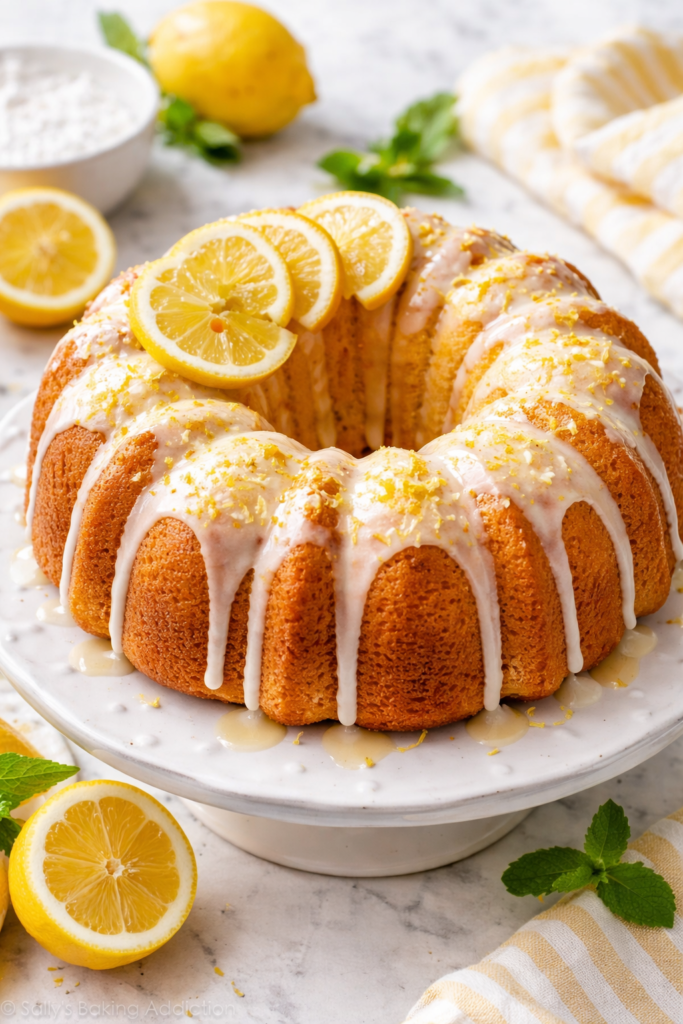
Step 8: Make and Pour the Glaze
Whisk together the sifted powdered sugar, lemon juice, and zest until smooth. You want a thick but pourable consistency. If it’s too thick, add lemon juice ½ tsp at a time.
While the cake is still slightly warm (not hot), pour the glaze over the top, letting it drip naturally down the sides.
Let the glaze set for 15-20 minutes before slicing.
Leftovers and Storage
Room temperature: Cover the cake tightly with a cake dome or plastic wrap. Keeps well for 3 days. The flavor actually deepens on day 2.
Fridge: Store for up to 5 days. Let individual slices come to room temperature before eating for the best texture.
Freezer: Slice and freeze individual portions wrapped in plastic, then placed in a freezer bag. Pull out a slice whenever you need it. It thaws in about 30 minutes on the counter.
Don’t refrigerate unsliced if you can help it. The cold can dry out the crumb over time.
FAQ
Why did my cake stick to the pan? Almost always a pan prep issue. Every single groove needs butter and flour. If you’ve had sticking problems before, you can also use a baking spray specifically formulated for bundt pans (like Baker’s Joy).
Can I use cake flour instead of all-purpose? Yes. Cake flour will give you an even more tender, delicate crumb. Use the same amount but know the cake will be slightly more fragile when you unmold it.
My glaze soaked in and disappeared. What happened? The cake was still too warm when you glazed it. Let it cool longer next time. A fully cooled cake will have a beautiful white glaze that sets on top.
Can I make this in two loaf pans instead? Yes. Divide the batter evenly. Bake at 325°F for 45-55 minutes and check with a toothpick.
The top of my cake cracked. Is that normal? Completely normal and actually expected with bundt cakes. The top (which becomes the bottom once flipped) often cracks from the rise. You’ll never see it once it’s plated.
Can I add a lemon syrup soak? Yes and it’s incredible. While the cake is still hot, poke holes all over with a skewer and pour over a warm mixture of ¼ cup lemon juice and ¼ cup granulated sugar. Then glaze as normal once cooled. It makes the cake impossibly moist.
Wrapping Up
A lemon bundt cake is one of those things that feels a little elevated without actually being complicated.
Once you’ve made it, you’ll find yourself coming back to it again and again because it just works. Every time.
Make it for a friend’s birthday. Make it because you have lemons you need to use. Make it because it’s Sunday and you feel like baking something that’ll make your whole kitchen smell incredible.
Then leave a comment below and tell me how yours turned out! Did you add blueberries? Try the cream cheese glaze? I’d love to hear your version.