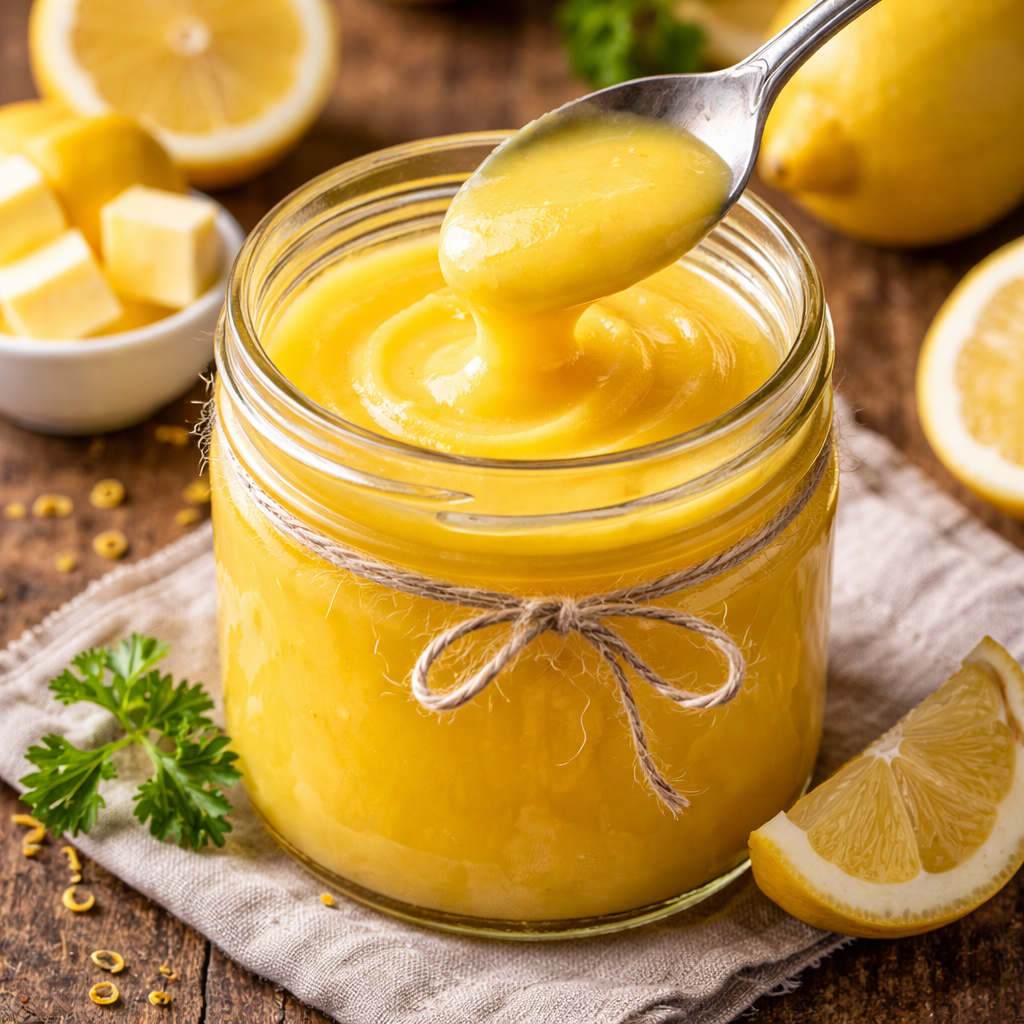
You know that moment when you taste something and you’re like… why have I been settling for the jar version this whole time?
That’s exactly what happened to me the first time I made lemon curd from scratch.
It’s silky, it’s bright, it’s almost aggressively lemony in the best possible way. And the kicker? It takes about 15 minutes and five ingredients.
Once you make it, you’ll use it on everything. Toast, scones, yogurt, cake filling, straight off the spoon at midnight. No judgment here.
What You’ll Need
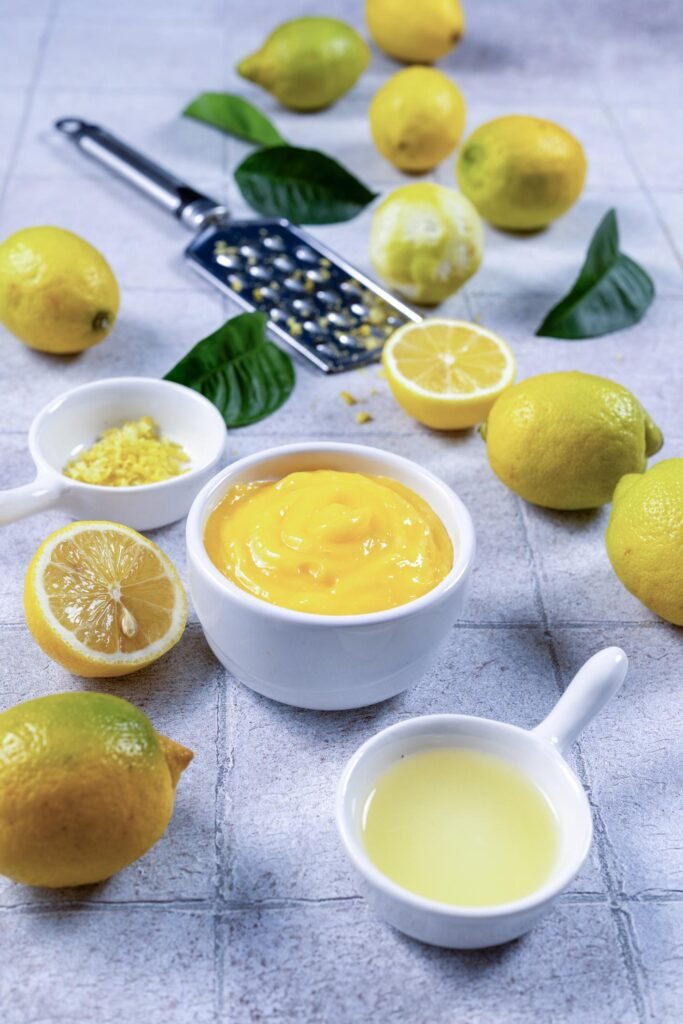
Here’s what you’re pulling out before you start:
The ingredients:
- 3 large eggs
- 3 large egg yolks
- 3/4 cup (150g) granulated white sugar
- 1/2 cup (120ml) fresh lemon juice (about 3–4 lemons)
- 1 tablespoon lemon zest (from the same lemons)
- 6 tablespoons (85g) unsalted butter, cold, cut into cubes
- Pinch of fine sea salt
The tools:
- Medium saucepan
- Heatproof bowl (glass or stainless steel)
- Fine mesh strainer
- Whisk
- Microplane or zester
- Juicer or citrus press
- Rubber spatula
- Glass jar or airtight container for storing
Pro Tips
These are the things I wish someone had told me the first time:
- Use cold butter. Adding cold butter at the end is what makes lemon curd so glossy and smooth. Room temperature butter works, but cold butter gives you that restaurant-quality finish.
- Don’t walk away from the stove. Lemon curd goes from perfect to scrambled eggs surprisingly fast. Keep stirring and keep the heat at medium-low the whole time.
- Always strain it. Even if yours looks smooth, run it through a fine mesh strainer. It catches any cooked egg bits you didn’t notice and makes the texture incredibly silky.
- Zest before you juice. You cannot zest a juiced lemon. Ask me how I know.
- Taste as you go. Lemons vary a lot in sweetness and acidity. Once you’ve added the butter, taste it. Too tart? Add a little more sugar. Too sweet? Add a small squeeze more of lemon.
The Full Instructions
Step 1: Zest and juice your lemons.
Zest the lemons first using a microplane, then cut and juice them. You need 1/2 cup of juice and 1 tablespoon of zest.
Step 2: Whisk the eggs, yolks, and sugar.
In your heatproof bowl, whisk together the 3 whole eggs, 3 egg yolks, and 3/4 cup of sugar until combined. Whisk in the lemon juice, lemon zest, and pinch of salt.
Step 3: Cook it over a double boiler.
Set the bowl over a saucepan with about an inch of barely simmering water (the bowl should not touch the water). Stir constantly with a rubber spatula or whisk. Keep the heat at medium-low.
Step 4: Watch for the thickening.
After about 10–12 minutes of stirring, the curd will thicken enough to coat the back of a spoon. When you run your finger across the back of the spoon and it holds a clean line, it’s done. The temperature should read about 170°F (77°C) if you have a thermometer.
Step 5: Add the cold butter.
Take the bowl off the heat. Add the cold butter cubes a few at a time, stirring until each piece melts before adding the next. This takes about 2–3 minutes total.
Step 6: Strain and store.
Pour the curd through a fine mesh strainer into a clean glass jar or container. Press gently with the spatula to push it through. Let it cool at room temperature for 15 minutes, then press plastic wrap directly onto the surface (this prevents a skin from forming) and refrigerate.
It thickens even more as it cools. Give it at least an hour in the fridge before using.
Substitutions and Variations
Dairy-free: Replace butter with refined coconut oil. The flavor will be slightly different but still delicious.
Lime curd: Swap the lemon juice and zest for lime. Incredible on coconut cake or just on toast.
Orange curd: Use blood orange juice for something a little unexpected. Great on pancakes.
Meyer lemon curd: If you can find Meyer lemons, use them. They’re sweeter and floral and the curd they make is absolutely stunning.
Reduce the sugar: You can drop to 1/2 cup sugar if you want something more tart. Just taste and adjust.
Make-Ahead Tips
Lemon curd is actually a great make-ahead recipe.
- Make it up to 2 weeks in advance and store in the fridge in an airtight jar.
- You can also freeze it for up to 3 months. Freeze in small portions so you can thaw only what you need.
- Thaw overnight in the fridge, then give it a good stir before using.
Nutritional Info + Diet Notes
One tablespoon of lemon curd contains approximately:
| Nutrient | Amount |
|---|---|
| Calories | ~50 kcal |
| Fat | 3g |
| Carbohydrates | 6g |
| Sugar | 5.5g |
| Protein | 0.7g |
For different diets:
- Gluten-free: This recipe is naturally gluten-free. ✓
- Dairy-free: Use coconut oil instead of butter.
- Lower sugar: Reduce sugar to 1/2 cup and taste before straining.
- No cholesterol concerns? The egg yolks give it richness, but you can try using all whole eggs (5 total) for less richness with slightly different texture.
What to Pair It With
Lemon curd is incredibly versatile. Here are some pairings that work really well:
- Spread on scones or biscuits
- Layered inside a vanilla or almond cake
- Stirred into plain Greek yogurt
- Spooned over vanilla ice cream
- Used as a filling for crepes or French toast
- Mixed into whipped cream for a lemon mousse
- Spread on toast with a sprinkle of sea salt (trust me on this one)
Leftovers and Storage
- Store in a clean glass jar with a tight lid in the refrigerator.
- Keeps well for up to 2 weeks in the fridge.
- For best results, press plastic wrap directly onto the surface before sealing to keep it from developing a skin.
- Freezes well for up to 3 months. Thaw overnight in the refrigerator.
- Do not leave at room temperature for more than 2 hours because of the eggs.
FAQ
Why did my lemon curd turn out lumpy?
The heat was too high or you stopped stirring, and the eggs cooked unevenly. Always strain through a fine mesh strainer — it saves most batches.
Can I make it without a double boiler?
You can cook it directly in the saucepan over very low heat, but you have to stir constantly and watch it closely. A double boiler gives you more control.
Why isn’t my curd thickening?
Give it more time. Some batches take up to 15 minutes. If it’s been 20 minutes and nothing is happening, your heat might be too low. Try bumping it up slightly while stirring constantly.
Can I use bottled lemon juice?
Technically yes, but the flavor difference is noticeable. Fresh lemon juice has a brightness that bottled just doesn’t have. If flavor matters to you (and it should 😄), go fresh.
How do I know if it’s gone bad?
If it smells off, looks watery, or shows any mold, toss it. A good lemon curd should smell bright and citrusy and have a smooth, thick consistency.
Can I double the recipe?
Absolutely. Just use a larger bowl and expect the cooking time to increase slightly, around 15–18 minutes instead of 10–12.
Wrapping Up
Lemon curd is one of those recipes that feels a little fancy but is actually totally approachable.
Five ingredients. Fifteen minutes. And suddenly you have something that tastes like it came from a really good bakery.
It’s the kind of thing you make once and then find yourself making on repeat because you start putting it on everything. Scones, cake layers, yogurt, toast at 11pm… it’s all fair game.
Give it a try this weekend and let me know how it goes in the comments below. Did you use it on something unexpected? Hit a snag and figured it out? I genuinely want to know. Drop your experience (and any questions) below!